Showing posts with label accessibility. Show all posts

Monday, December 6, 2021

Accessibility - Handrail

 Sometime people want to be festive. And they do not realize that the decoration can open themselves up to a lawsuit.
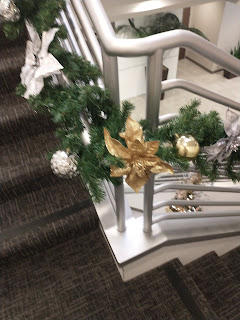

Here is a festive decoration. It obscures the handrail. The decoration could have just as easily been place on to of the guard rail and limit liability. 


CBC 11B -505.6 Gripping surface. Handrail gripping surfaces
shall be continuous along their length and shall not be
obstructed along their tops or sides. The bottoms of handrail
gripping surfaces shall not be obstructed for more than 20
percent of their length. Where provided, horizontal projec¬
tions shall occur l72 inches (38 mm) minimum below the
bottom of the handrail gripping surface.

Friday, August 6, 2021

Q&A on accessible path of travel, stairs, handrails, guardrails


When do we need a interim rail on stairs – Monumental stairs (the main path of exit should have rails on both sides)

Where the required exit width is wide you need intermediate rails. Each hand rail can serve 30” of exit width, so you can have a single pair of handrails serve up to 60” of exit width. (60” = 300 people of exit width).

When do we need the tighter coverage (4” openings) and when we can just have an intermediate horizontal rail Where the fall distance on the other side of the rail is 30” or more.

At maintenance stairs / ramps (no public) the opening between rails cannot allow the passage of a 21” sphere in place of 4” sphere (typical requirement).

How long the level landing rail at the bottom of the stairs needs to be Extension of the handrail at the end of a stair run is 12” plus the length of the typical tread. (Ramp handrail extension is 12”)

What the clearance are for path of travel.

Sidewalk = 48” CLR, Cut Thru Islands = 48” CLR, inside building path of travel = 36” CLR,

Thursday, August 9, 2012

Specific Accessibility References

There is often a temptation to go beyond the text when it comes to code compliance. Many times designers and contractors add a little extra. In most cases adding a bit of margin of error is justified. Wider corridors benefit everyone, not just the wheelchair users. Clearances in restrooms are beneficial to the portly and those with limited use of legs.

Some plan checkers and some inspectors will ask for clearances where they do not apply. Case in point toilet tissue dispensers in accessible stalls, can they project out more than 4"?

ANSI 604.3.2 Overlap. The required clearance around the water closet shall be permitted to overlap the water closet, associated grab bars, paper dispensers, sanitary napkin receptacles, coat hooks, shelves, accessible routes, clear floor space at other fixtures and the turning space. No other fixtures or obstructions shall be within the required water closet clearance.
2010 CBC 111SB.S.4 Toilet tissue dispensers. Toilet tissue dispensers shall be located on the wall within 12 inches (305 mm) of the front edge of the toilet seat, mounted below the grab bar, at a minimum height of 19 inches (485 mm), and 36 inches (914 mm) maximum to the far edge from the rear wall. Dispensers that control delivery or that do not permit continuous paper flow shall not be used. See Figure 11B-1A.


The code language and figures do not mention projection. You do not need a recessed toilet tissue dispenser and its associated costs in order to comply. Now you may want recessed accessories in order to fulfill your design objectives, but don't hide behind a non-existent code requirement.

I am an architect licensed in three states, however everything you read on the internet should be verified with a design professional in your jurisdiction.

Tuesday, February 22, 2011

Accessibility

I came across another blog that recounts the myriad codes surrounding accessibility. You may find it here.

Friday, September 11, 2009

reminder of where accessibility laws come from...

The Architectural Barriers Act (ABA), a federal law created in 1968 that stipulates all buildings, other than privately owned residential facilities, constructed by or on behalf of, or leased by the United States, or buildings financed in whole or in part by the United States, must be physically accessible for people with disabilities.
 The Rehabilitation Act is a federal law first passed in 1973. The purpose of Section 504 of the Rehabilitation Act was to make sure that people with disabilities will have the same opportunities in federally funded programs as people without disabilities. For example, this section is very important in the design of schools and universities. Both physical access to the buildings and spaces, as well as equal access to participation in the programs, must be available.

Thanks to ICC for summary

Saturday, May 10, 2008

History of Accessibility

Sometime it helps to learn about the past before pressing into the future. Accessibility is presently considered a civil right in the United States of America. I received the e-mail below from one of the most knowledgeable people in California on the subject.

From: Mankin, Michael
Sent: Wednesday, April 09, 2008 9:51 AM
Hello,
Well, no online history – just the Attorney General's site:
https://oag.ca.gov/civil/major-initiatives

CA has little institutional memory, yet archives exist in various agency records where the law requires retention.  One of the best timelines is online at DREDF:
http://www.dredf.org/about/dredf_timeline.shtml

DSA had a ANSI standard applied to new state funded buildings from 1969 until 1982, but no path of travel for existing buildings until after that. Local enforcement followed suit in 1970.

I find that every administration develops its own version of history according to the current political agenda.

Here is federal timeline:
TIMETABLE OF LEGISLATION AND ACCESSIBILITY GUIDELINES FROM 1961 TO 1998:

1961 ANSI publishes ANSI A117.1, Making Buildings Accessible to and Usable by the Physically Handicapped.
1965 Congress passes the Vocational Rehabilitation Amendment Act (P.L. 89-333).
1968 Congress passes the Architectural Barriers Act (ABA) (P.L. 90-480).
1973 Congress passes the Rehabilitation Act (P.L. 93-112).
1978 Sections 502 and 504 of the Rehabilitation Act of 1973 (P.L. 93-112) are amended.
1980 ANSI publishes a revised version of ANSI A117.1, designated ANSI A117.1-1980.
1982 U.S. Access Board publishes Minimum Guidelines and Requirements for Accessible Design (MGRAD).
1984 Federal ABA rule-making agencies (HEW, DOD, HUD, USPO) publish Uniform Federal Accessibility Standard (UFAS).
1986 ANSI publishes revised version of ANSI A117.1, designated ANSI A117.1-1986.
1988 Congress passes the Fair Housing Amendments Act (P.L. 100-430).
1990 Congress passes the Americans with Disabilities Act (P.L. 101-336).
1991 U.S. Access Board publishes Americans with Disabilities Act Accessibility Guidelines for  Buildings and Facilities (ADAAG).
1991 U.S. Departments of Justice and Transportation publish the ADA Standards for Accessible Design.
1992 ANSI publishes a revised version of ANSI A117.1, designated CABO/ANSI A117.1-1992.
1995 Congress passes the Congressional Accountability Act.
1998 ANSI publishes a revised version of ANSI A117.1, designated CABO/ANSI A117.1-1998.
1998 Congress reauthorizes the Rehabilitation Act.
2004 U.S. Access Board publishes new Americans with Disabilities Act / Architectural Barriers Act   Accessibility Guideline (36 CFR Parts 1190 and 1191)
 Michael J. Mankin

Supervising Architect
Division of the State Architect, Headquarters Office
Department of General Services
1102 Q Street, Suite 5100
Sacramento, CA 95811-6550
BUILDING GREEN  •  BUYING GREEN  •  WORKING GREEN

Order of the Arrow

The Order of the Arrow was a service organization within the Boy Scouts of America. It originally had three foci. 1) Brotherhood 2) Service ...